Walking into data analytics for the first time feels overwhelming. Everyone tells you to learn Python, SQL, Tableau, Power BI, and R, all at once, so where do you actually start on day one?
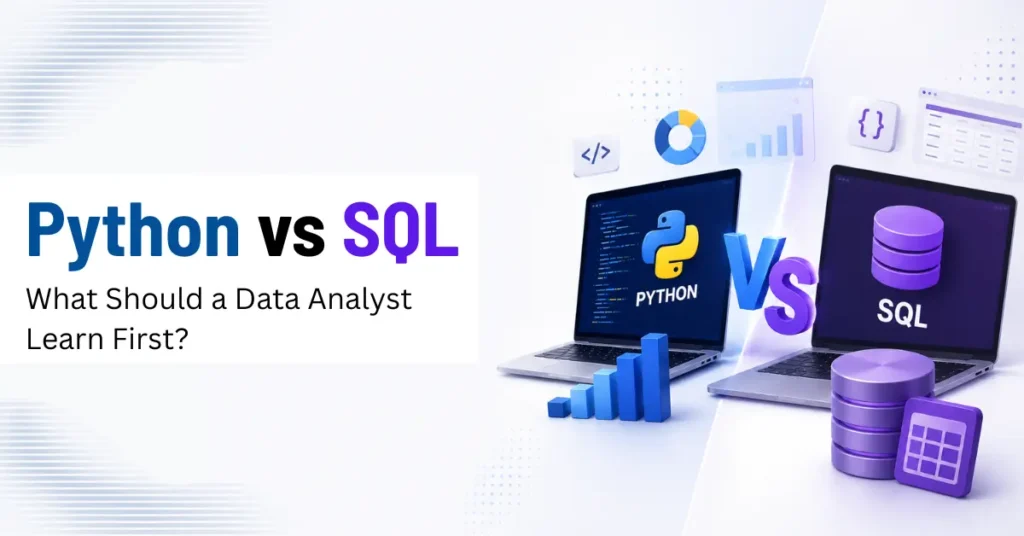
Here’s the first thing to clear up. Python vs SQL for data analysis is not an either or choice. You will eventually need both if you want a real career in data analytics. The question most beginners are really asking is what to learn first, Python or SQL, and the answer depends on your background, timeline, and goals.
This guide walks through that decision step by step, so you can build a data analyst roadmap that fits where you’re starting from, whether you’re completely new to coding or already have some programming background.
Understanding SQL: The Bedrock of Data Storage
SQL, short for Structured Query Language, is the universal language used to talk to databases. Almost every company, from small startups to global banks, stores its data in some form of relational database, and SQL is how you pull information out of it. This is one of the most common SQL use cases in data analytics, and it’s usually the first skill a new analyst is asked to show.
At its core, SQL handles storing, retrieving, filtering, and joining data across tables. Think of SQL as walking into a large grocery store and knowing exactly which aisle, shelf, and item to grab, without wasting time wandering around.
The key skills you’ll build here include writing SELECT statements, filtering with WHERE clauses, combining tables with JOINs, grouping results with GROUP BY, and running aggregate functions like SUM and COUNT. These are the daily tools behind nearly every reporting and dashboarding task in a business analytics job.
Most companies also expect familiarity with CRUD operations (create, read, update, delete) as a baseline skill for any data role built around relational databases.
Understanding Python: The Powerhouse of Data Manipulation
Python is a general purpose programming language that happens to excel at advanced data science. Unlike SQL, which is built only to query data, Python can clean messy data, run statistical models, automate repetitive tasks, and build machine learning algorithms from the ground up.
Think of Python as taking those raw groceries home and cooking a full meal with several courses and complex recipes. SQL gets you the ingredients. Python is what you do with them once you’re in the kitchen.
The Python data analysis libraries that matter most here are Pandas for cleaning and reshaping datasets, NumPy for numerical calculations, and Matplotlib for turning that data into charts and visuals. These three form the backbone of nearly every data analytics workflow used in real jobs today.
Where SQL retrieves information, Python interprets it, tests it, models it, and often automates the entire process so it runs on its own every day without manual work.
Python vs SQL: The Comparison at a Glance
Feature | SQL | Python |
Primary purpose | Fetching and querying data from databases | Analyzing, cleaning, and modeling data |
Learning curve | Easy to moderate, basics in about two weeks | Moderate to steep, requires coding logic |
Data size capacity | Handles large databases with ease | Limited by your computer’s available memory |
Best for | Data retrieval, aggregations, reporting | Machine learning, automation, deeper analytics |
Job requirement | Required for almost all data jobs | Strongly preferred, required for advanced or senior roles |
The Verdict: What Should You Learn First?
This is the core question most readers came here for, so let’s break it down by scenario.
Choose SQL first if:
- You want to become job ready as fast as possible. SQL shows up in more than 90 percent of entry level business analyst and data analyst job postings.
- You don’t have a coding background and want the easier learning curve.
- You want to work with existing data systems in traditional sectors like banking, retail, or healthcare.
Choose Python first if:
- You’re aiming directly for roles in machine learning, AI, or predictive data science.
- You want to build automated pipelines, such as scraping data from the web or sending yourself a daily automated report.
- You already have some programming background, in Java, C++, or similar languages.
Recommended path: For about 80 percent of beginners, the ideal order is to learn SQL first, from basics through intermediate level, get comfortable pulling and filtering data, and then move into Python to learn how to analyze what you’ve pulled. This sequence mirrors how data analyst skills are actually used on the job, where you almost always query before you model.
How Python and SQL Work Together in the Industry
Once you’re past the beginner stage, it becomes clear that SQL and Python aren’t rivals. They’re a team, and understanding data engineering vs data analysis workflows makes this obvious.
Here’s how a typical workflow plays out. First, you use SQL to extract data from a database with ten million rows and filter it down to the fifty thousand rows that actually matter for your analysis. Then, you pass those fifty thousand rows into Python, using Pandas, to run statistical tests, handle missing values, and build a prediction model.
This is also where the question of Pandas vs SQL queries becomes less about choosing sides and more about knowing which tool fits which stage of the job. SQL narrows the data down. Python digs into what’s left.
Conclusion
If you’re planning to learn data analytics, the practical answer is to start with SQL, build real comfort with querying and filtering data, and then bring Python in once you need to go deeper than a spreadsheet or dashboard can take you.
Neither skill replaces the other. Together, they cover the full path from raw data sitting in a database to a finished insight ready for a decision, and that combination is what most data analyst skills actually come down to on the job. Learners who want to build both sides of this path can start with a structured Python programming course and a Python for Data Science course in Singapore to cover the Python side once SQL basics are in place.