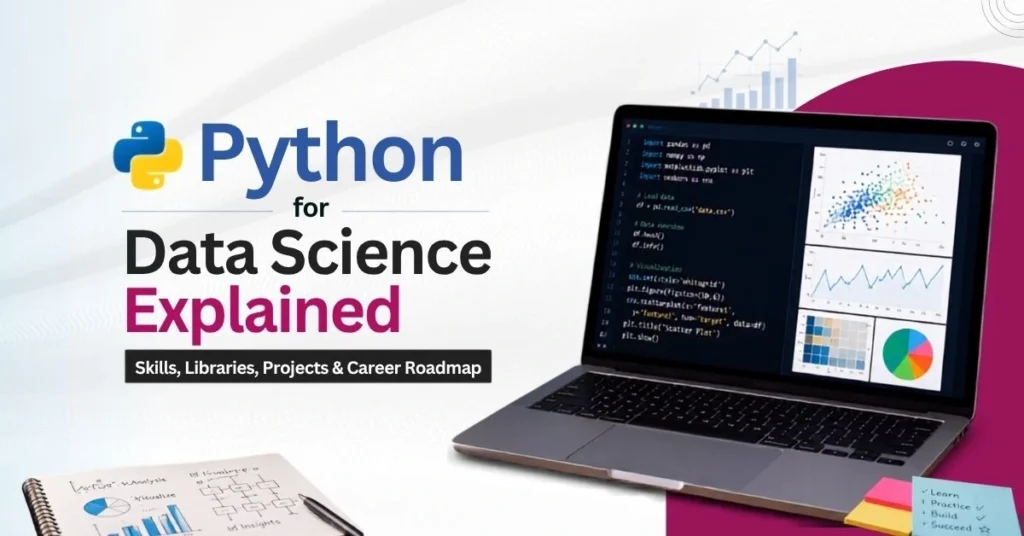
Data science is the process of collecting, cleaning, analysing, and interpreting data to support decisions. It combines statistics, programming, and domain knowledge to turn raw numbers into practical insight. Python has become the language most closely tied to this field because it handles every stage of that process, from importing a spreadsheet to building a predictive model, without forcing a learner to switch tools.
Python for data science is used across banking, healthcare, retail, logistics, and technology companies. Analysts use it to study customer behaviour, researchers use it to process experimental data, and engineers use it to build systems that learn from patterns. What ties these uses together is that Python keeps the work readable, even when the analysis behind it is complex.
Why Python Is the Preferred Language for Data Science
Several practical reasons explain why so many professionals choose to learn python for data science over other languages.
Its syntax reads close to plain English, which shortens the learning curve for people who have never coded before. It is open source, so there is no licence cost attached to using it for research or business analysis. A large, active community maintains forums, tutorials, and documentation, which makes it easier to solve problems while learning.
Python also carries a wide range of libraries built specifically for data work, and it connects well with artificial intelligence and machine learning tools. As python programming for data science grows from a small script to a system handling millions of records, Python grows with it rather than needing a rewrite in another language.
Skills Required Before Learning Python for Data Science
A learner does not need a technical background to begin, but a few foundations make the process smoother.
Basic Computer Knowledge:- Comfort with files, folders, and installing software helps when setting up a Python environment.
Logical Thinking:- Data science involves breaking a question into smaller steps, which benefits from structured reasoning.
Problem-Solving:- Most real datasets are messy, so the ability to work through unexpected issues matters more than memorising syntax.
Mathematics Fundamentals:- A working knowledge of algebra supports understanding how formulas behave inside code.
Basic Statistics:- Concepts such as mean, median, and standard deviation appear constantly in data analysis.
Data Handling Concepts:-Understanding how data is organised in rows and columns makes libraries such as Pandas easier to grasp later.
These are the core python skills for data science, and the same list applies to the wider set of skills required for data science with python before moving on to code.
Python Fundamentals Every Beginner Should Learn
Before working with data, a learner should be comfortable with the parts of the Python language itself: variables, data types, operators, and strings, along with conditional statements and loops that control how a program runs. Functions allow code to be reused instead of repeated, while lists, tuples, dictionaries, and sets provide different ways to store and organise information.
File handling teaches a learner to read and write data from external sources, and exception handling shows how to manage errors properly instead of letting a program stop unexpectedly. These fundamentals form the base that every data science library sits on top of, which is why this stage matters so much for python for data science beginners.
Key Python Libraries for Data Science
A small set of libraries covers most of the work involved in python libraries for data science.
Library | Purpose | Where It’s Used |
NumPy | Numerical Computing | Arrays & Calculations |
Pandas | Data Analysis | Cleaning & Manipulation |
Matplotlib | Visualization | Reports |
Seaborn | Statistical Charts | Exploratory Data Analysis |
Plotly | Interactive Dashboards | Business Analytics |
Scikit-learn | Machine Learning | Predictive Models |
SciPy | Scientific Computing | Statistics |
Most learners start with NumPy and Pandas, since almost every later step depends on being able to organise and clean a dataset first. These make up the Python libraries every data scientist should know before moving into visualisation or modelling.
Understanding the Data Analysis Workflow in Python
A typical python data analysis workflow follows a consistent sequence. It begins with collecting data from a source such as a survey, database, or sensor, followed by importing that dataset into Python using a library like Pandas.
Once imported, the data is rarely ready for use. Cleaning removes duplicate or irrelevant entries, and handling missing values decides whether to fill, estimate, or remove incomplete records. Data transformation reshapes the dataset into a format suited for analysis, which is followed by exploratory data analysis (EDA) to understand patterns and relationships. Feature engineering then creates new variables that make later modelling more effective, before the process closes with reporting insights in a clear, usable form. Most analysts pair this Python-based workflow with database skills, since knowing Python vs SQL: What Should a Data Analyst Learn First helps decide how each fits into a data analysis career.
Data Visualisation with Python
Numbers alone rarely tell a complete story, which is why visualization is a core part of Python for data science. Line charts work well for showing trends over time, while bar charts compare values across categories. Pie charts show proportions within a whole, and histograms reveal how a single variable is distributed.
Scatter plots help identify relationships between two variables, heatmaps highlight patterns across a matrix of data, and box plots summarise the spread and outliers within a dataset. Choosing the right chart type depends on the question being asked rather than personal preference, and this judgement develops with practice.
Introduction to Machine Learning with Python
Machine learning extends data science by allowing a program to identify patterns and make predictions rather than following fixed rules. It falls into two broad categories.
Supervised learning trains a model on labelled data, where the outcome is already known, and includes tasks such as regression for predicting numeric values and classification for predicting categories. Unsupervised learning works with unlabelled data and includes clustering, which groups similar records together without predefined labels.
Within the Python programming for data science workflow, machine learning typically comes after the data has been cleaned and explored, since a model is only as reliable as the data used to build it.
Python Projects for Data Science Beginners
Beginner-level python projects for data science include a student marks analysis to practise basic statistics, an expense tracker to work with everyday data, a weather data analysis project to explore time-based trends, and a sales dashboard to combine analysis with visualisation. These are good starting points for beginner Python data science projects.
Once these feel comfortable, intermediate projects such as customer segmentation, a movie recommendation system, house price prediction, and customer churn prediction introduce machine learning concepts in a practical setting.
Tools Every Python Data Scientist Should Know
Alongside the language itself, a set of supporting tools makes daily work easier. Jupyter Notebook and Google Colab are commonly used for writing and testing code in small, visible steps, while VS Code suits larger projects that need a full development environment.
GitHub helps track changes and share work, and Kaggle provides datasets and competitions for practice. Anaconda simplifies managing Python packages, SQL remains useful for working with structured databases, and Docker helps package projects so they run consistently across different systems.
Python Career Roadmap for Data Science
Learning python for data science is easier to plan when broken into stages, which is the idea behind a python career roadmap.
Learning Stage | Skills to Focus On |
Beginner | Python Fundamentals |
Foundation | NumPy & Pandas |
Intermediate | Data Analysis & Visualization |
Advanced | Machine Learning |
Professional | Portfolio & Real-world Projects |
Each stage builds on the previous one, so this table works as a python roadmap for beginners and, followed step by step, as a python for data science step by step guide rather than a fixed rulebook.
Common Mistakes Beginners Should Avoid
A few habits tend to slow down progress for those learning python for data science; python for data science beginners often run into the same set of issues.
Skipping the basics to jump straight into libraries leaves gaps that surface later. Ignoring statistics makes it harder to interpret results correctly, and trying to learn too many libraries at once often leads to shallow familiarity rather than real skill. Not building projects keeps knowledge theoretical, while copy-pasting code without understanding it prevents real learning. Avoiding GitHub means missing out on a normal industry habit, and inconsistent practice makes it difficult to retain what has been learned.
How Long Does It Take to Learn Python for Data Science?
The timeline varies by individual effort, but here is a general guide to how long does it take to learn python for data science.
Goal | Estimated Time |
Python Basics | 4–6 Weeks |
Core Libraries | 1–2 Months |
Data Analysis | 2–3 Months |
Machine Learning Basics | 2–3 Months |
Portfolio Projects | Ongoing |
Portfolio building continues well beyond the first learning period, since new projects keep skills current.
Career Opportunities After Learning Python for Data Science
Once the main skills are in place, several career paths open up as part of data science with python. A data analyst focuses on interpreting data and reporting insights, while a data scientist builds on that with statistical modelling and machine learning. A machine learning engineer builds and deploys predictive systems, and a business intelligence analyst turns data into dashboards and reports for decision-makers.
An AI engineer applies machine learning to wider intelligent systems, and a data engineer builds the systems that move and store data reliably. Each role draws on the same python career roadmap described above, with the difference lying in how far a person specialises in analysis, modelling, or systems work.
Conclusion
Learning python for data science is a gradual process that moves from language fundamentals to libraries, analysis, visualisation, and eventually machine learning. Progress depends less on speed and more on steady practice, hands-on projects, and a willingness to keep learning as tools and techniques change. Many learners choose a structured Python for Data Science course in Singapore to build these skills through instructor-led, hands-on training instead of piecing resources together on their own.